
Draft report due 1 week after lab date
Final report due 2 weeks after lab date
We will be working in the robotics lab to capture data (video-based). Then you can do the analysis using Matlab.
For this lab you will be modeling the behavior of your arm as you move it between two positions. We will be modeling this as a simple 2nd order rotational system and be looking for changes in the model parameters as your arm gets tired.
The final product of this lab should be a characterization of the behavior of your arm. In particular, you are looking to see if you can characterize your arm as underdamped, critically damped, or overdamped. There is some expectation that it is not an unstable system.
As before, please work in groups of 2-3 people. Feel free to change lab groups if you wish.
For this lab you will be investigating moving your forearm between a 90 degree bent position and a straight arm, bending only at the elbow. We will be tracking the hand and elbow using a video camera.
We can model this motion using a simple mass/spring/damper rotational system. The mass is your forearm, and the muscles provide the spring and damping forces. While this is not a strictly correct model of what is going on, it is close enough for us to characterize the system.
We can treat moving your arm from one position to another as a zero-input response to an offset. In other words, your arm wants to be stretched out, but you have bent it back to 90 degrees and are going to let it go.
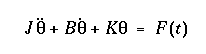
The basic equation of motion is:
Taking the Laplace Transform of this expression, with initial conditions, we get the following:

Reorganizing the initial conditions to the right side, we get closer to a standard form.
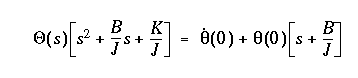
Finally, we can make the substitution that B/J = 2 * alpha and K/J = natural undamped frequency.
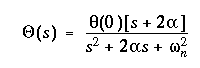
When this system is overdamped, the roots of the denominator are real and negative. When the roots are complex conjugates of one another, the system is underdamped, and will oscillate before coming to rest. Finally, if the roots are purely complex or lie in the right half of the complex plane the system is purely oscillatory or unstable.
The time domain solution for the damped system is a pair of exponentially decreasing functions. You can identify the different time constants by factoring the polynomial. The roots will identify the time constant--the larger the root, the longer the time constant. If you have two identical real, roots, then the system is critically damped.
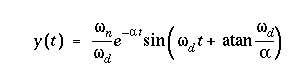
The time domain system for the underdamped system is:
Have fun with this lab
Make a web page that shows your models, experiments, and conclusions. Organize it so that there is a main page that gives a discription of the task and a summary of all the cases you explored. This page should also include a brief discussion of what you discovered and your conclusions, and it needs to have any extra derivations, outside information, or calculations you made. From the main page link each of the cases, as appropriate. You should combine cases to make a point--for example, somewhere in your writeup you should have a table with the results for weight/no weight.
Send the URL to Prof. Maxwell when it is ready for viewing.